BlackRock Leaders Say Tokenization Will Transform Global Finance
Here’s What It Means and What Comes Next
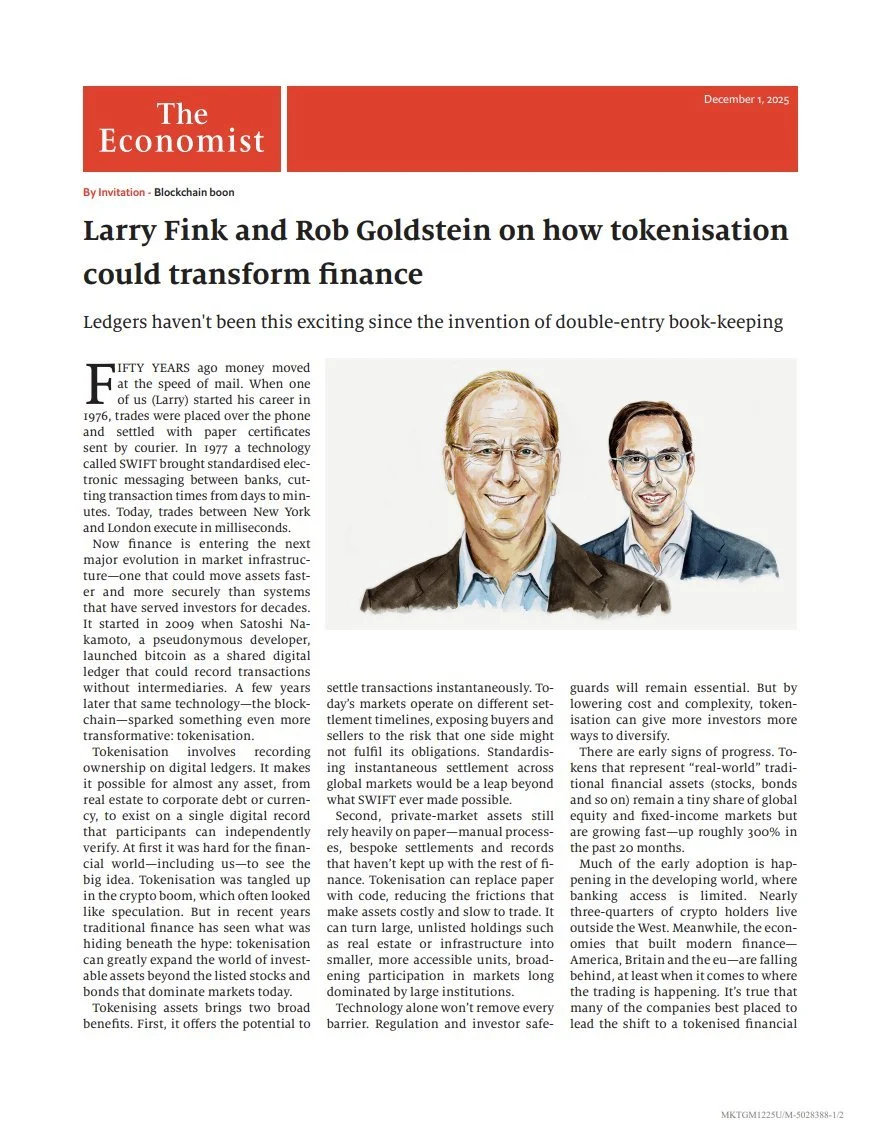
BlackRock CEO Larry Fink and President Rob Goldstein published a major essay in The Economist arguing that the next evolution of global finance will be driven by tokenization, the process of putting real-world assets like real estate, bonds, and funds on blockchain-based digital ledgers.
For readers unfamiliar with the concept, their message is simple:
Tokenization could upgrade the entire financial system, just as email replaced physical mail and SWIFT replaced paper settlement slips.
Backed by BlackRock’s massive $13.5 trillion in assets under management, this essay represents one of the clearest signals yet that traditional finance is preparing to embrace blockchain technology at scale.
What Is Tokenization? (Explained in 20 Seconds)
Today, most financial assets exist inside slow, fragmented, and expensive systems:
stock trades settle in 2 days
global transfers require intermediaries
private assets require manual paperwork
settlement and clearing rely on decades-old infrastructure
Tokenization replaces these systems by issuing assets as digital tokens on a blockchain.
This has three major benefits:
1. Instant settlement (atomic trades)
Trades settle immediately and simultaneously which reduces counterparty risk.
2. Global access
Anyone with a digital wallet can buy or sell assets, potentially opening markets to millions.
3. Lower costs and fewer intermediaries
Less friction makes markets faster, cheaper, and more transparent.
According to BlackRock, tokenized assets have already grown 300% in the last 20 months, especially in emerging markets where traditional financial infrastructure is limited.
Why BlackRock Is Interested: A Simplified History Lesson
Fink and Goldstein compare today’s tokenization moment to two major milestones:
1. The creation of SWIFT in the 1970s
Before SWIFT, banks literally mailed paper instructions. SWIFT standardized messaging and cut settlement times from days to minutes.
2. The early internet in 1996
At that time, Amazon sold just $16 million worth of books. No one could imagine online commerce becoming the backbone of society.
BlackRock argues that tokenization is at a similar “early-internet” stage today: useful, growing quickly, and on the brink of an explosion in adoption.
Where Tokenization Is Growing Fastest
The essay notes that most early adoption is happening in:
developing countries
markets with limited banking infrastructure
ecosystems using stablecoins
digital-first financial platforms
BlackRock sees tokenization as a new bridge that connects:
Traditional finance (bonds, ETFs, private markets)
Digital finance (blockchains, stablecoins, smart contracts)
Rather than replacing the old system, tokenization enhances it.
One Big Catch: Trust and Safeguards
Tokenization cannot simply “move fast and break things.”
Fink and Goldstein emphasize that:
buyer protections
counterparty-risk standards
transparent reporting
regulatory guardrails
are non-negotiable, just like in the current system.
They invoke the 1929 stock market crash and subsequent reforms as a reminder that financial innovation must be matched with strong safety frameworks.
A blockchain-based bond is still a bond and must follow the same rules.
The 2026–2030 Outlook
Based on BlackRock’s analysis and the direction of global regulators, here’s what the next decade could look like:
1. Tokenized Treasury markets explode in size
U.S. Treasuries are the ideal early use case: stable, well-regulated, and high-volume.
BlackRock, Franklin Templeton, and Fidelity already offer tokenized T-bill funds.
Expect this to grow into a multi-trillion-dollar market.
2. ETFs shift to blockchain rails
BlackRock predicts that exchange-traded funds could eventually settle faster and more transparently using tokenized rails.
This could eliminate reconciliation delays and reduce costs for both issuers and brokers.
3. Private markets open up to global retail investors
Tokenization could allow fractional ownership of:
commercial real estate
private credit
infrastructure
fine art
small business equity
People could buy and hold many types of assets in a single digital wallet.
4. Banks and stablecoins begin to interoperate closely
Stablecoins already settle faster than many bank transfers.
BlackRock suggests that the future financial system will integrate both.
5. A new global settlement layer emerges
If tokenized markets scale, we could see a unified settlement network where:
bonds
stocks
cash
commodities
private assets
all settle instantly on interoperable digital rails.
This is the vision Fink and Goldstein are hinting at. The vision is to develop a modern SWIFT, but much faster and cheaper.
Why This Matters
Larry Fink is the world’s most influential asset manager.
When he and Rob Goldstein publicly argue that tokenization is the next leap forward in financial infrastructure, it signals:
institutional adoption is accelerating
tokenized markets will attract major liquidity
interoperability will define the next financial system
regulators will eventually standardize digital asset frameworks
This is not hype. It is the blueprint for the next 30 years of capital markets.