Ethereum Layer-2 TVL Hits a Two-Year Low: What Happens Next?
Contrary to its TVL, Ethereum’s Layer-2 ecosystem is not collapsing. But the truth is, it is entering a harsher phase of consolidation. A reported fall in Layer-2 total value locked, or TVL, to roughly $5 billion suggests that speculative capital, liquidity incentives and user attention are no longer spreading across rollups as easily as they did during the 2024 expansion.
According to The Block, Ethereum L2 TVL has returned to levels last seen in 2023. Base, Arbitrum and Optimism together hold approximately $4.8 billion, representing 96% of the measured total. That concentration matters: it suggests the market is selecting a few dominant networks while smaller Layer-2 chains struggle to retain capital and applications.
Does this mean Ethereum Layer 2 is failing?
Not necessarily. There is an important measurement caveat.
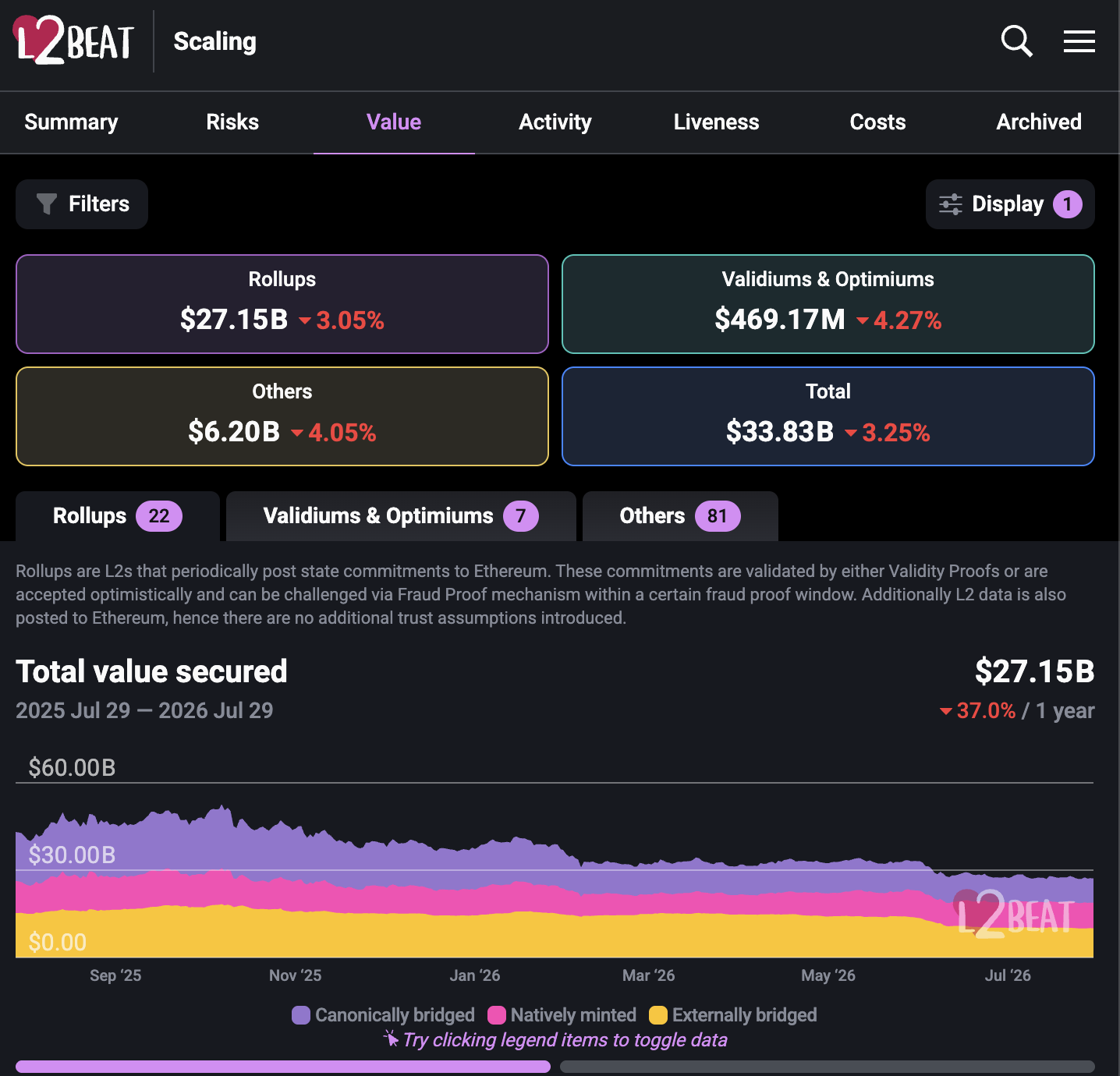
The reported $5 billion figure uses a narrower definition of value locked than L2BEAT’s “total value secured” metric. L2BEAT currently records approximately $33.8 billion across Ethereum scaling systems, including canonically bridged, natively issued and externally bridged assets. Investors should therefore treat the two-year low as evidence of declining capital within a particular category.
Liquidity will concentrate on fewer networks
When capital is fragmented across dozens of chains, each network has fewer traders, lenders and market makers. This can produce thinner liquidity, greater slippage and less sustainable yields outside the largest ecosystems.
Base, Arbitrum and Optimism may consequently become stronger while the long tail of general-purpose rollups becomes economically irrelevant. Smaller networks could be forced to merge, specialise, reduce incentives or shut down.
Layer-2 tokens face greater pressure
Networks dependent on token incentives may have to spend more to attract less capital. Lower economic activity can also weaken sequencer revenue, application fees and demand for governance tokens.
Investors may increasingly value Layer-2 networks as businesses with recurring users, defensible applications and genuine revenue, not simply as interchangeable “Ethereum scaling” narratives.
Ethereum still has a value-accrual problem
Ethereum’s Dencun upgrade introduced cheaper blob space for rollups, substantially reducing the cost of posting transaction data to Ethereum. That benefits users, but it also means greater L2 activity does not automatically create proportional mainnet fees, ETH burning or validator revenue.
Ethereum recorded exceptionally high transaction activity in early 2026, yet much of the growth came from Layer-2 and stablecoin settlement that did not translate cleanly into value for ETH holders.
Stablecoins remain Ethereum’s strongest defence
Stablecoin payments and settlement can remain active even when speculative DeFi activity declines. However, stablecoins are increasingly multichain. Visa’s settlement programme, for example, now supports nine blockchains, demonstrating that institutions can select whichever network offers the best combination of cost, liquidity, compliance and distribution.
The central consequence is therefore consolidation, not extinction. Investors should monitor bridge flows, stablecoin supply, active users, decentralised-exchange volume, application revenue and developer retention alongside headline TVL. The era in which launching another rollup was enough to attract users and liquidity may be ending.