Private Blockchains Still Can’t Compete With Databases, Research Shows
For more than a decade, private blockchains have been pitched as a quiet revolution inside enterprise finance and operations.
Unlike public blockchains, they promised speed, determinism, and enterprise-grade reliability. Banks, supply chains, and trading firms were told they could replace large parts of their database infrastructure while gaining transparency, auditability, and fault tolerance.
The message was simple.
Blockchains, but without the downsides.
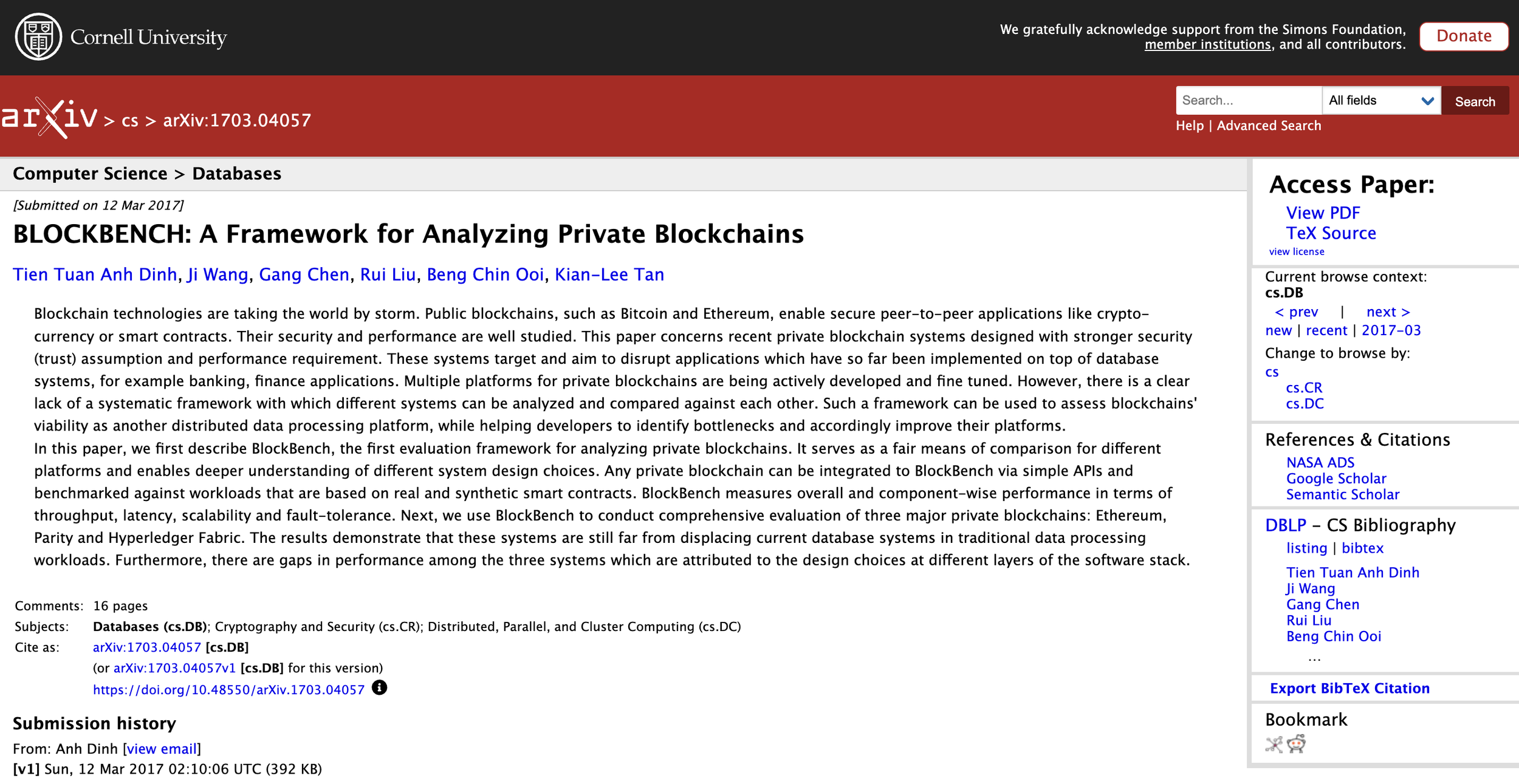
The research behind BLOCKBENCH puts this promise to a systematic test. Instead of debating blockchain ideology, it treats private blockchains as what they claim to be: distributed data processing systems. When evaluated on those terms, the results are difficult to ignore.
The real question BLOCKBENCH asks
By the mid-2010s, dozens of private blockchain platforms were being built in parallel. Each made different design choices around consensus, execution, and storage. Yet there was no rigorous way to compare them.
BLOCKBENCH exists to answer a practical question enterprises actually care about:
Can private blockchains compete with databases at the workloads databases already handle well?
Without a standardized benchmark, performance claims were anecdotal. Vendors highlighted best-case numbers. Bottlenecks were obscured. Enterprises were left making infrastructure decisions based on narratives rather than evidence.
BLOCKBENCH closes that gap by applying database-style benchmarking discipline to blockchain systems.
Why earlier evaluations missed the point
Before BLOCKBENCH, most performance analysis focused on public blockchains like Bitcoin and Ethereum. These studies emphasized throughput limits caused by proof-of-work and open participation.
Private blockchains were often assumed to be different. Because node identities are known and participation is permissioned, many believed performance constraints would largely disappear.
The research shows this assumption is wrong.
Even without proof-of-work, private blockchains inherit deep performance costs from their architectural foundations. These costs are not obvious when looking only at headline throughput numbers. They emerge only when systems are decomposed into layers and stressed with realistic workloads.
The key insight: blockchain performance is layered
The most important contribution of BLOCKBENCH is conceptual.
It frames blockchains as stacked systems, composed of three tightly coupled layers:
Consensus
Data model
Execution engine
This framing matters because performance bottlenecks do not come from a single source. In some systems, consensus dominates. In others, execution or storage becomes the limiting factor.
By designing benchmarks that isolate each layer, BLOCKBENCH shows that private blockchains do not fail for one reason. They fail for different structural reasons, depending on their design choices.
This is the nuance missing from most enterprise blockchain debates.
What the benchmarks actually reveal
When tested on standard workloads such as key-value storage and simple banking transactions, the performance differences are stark.
Hyperledger Fabric outperforms Ethereum and Parity in raw throughput, largely because it replaces proof-of-work with a PBFT-style consensus protocol. Under ideal conditions, Hyperledger reaches over 1,200 transactions per second.
But this apparent advantage collapses under scale.
Hyperledger struggles beyond roughly 16 nodes, not because PBFT is flawed in theory, but because communication overhead overwhelms the system in practice. As node count increases, consensus messages saturate the network and stall progress.
Ethereum fails differently. It scales more gracefully in node count, but suffers from extreme computational overhead. Proof-of-work consumes resources that could otherwise execute transactions, leading to high latency and low throughput.
Parity exposes yet another structural bottleneck. Its limiting factor is transaction signing, which caps throughput regardless of available compute or network capacity.
They are architectural trade-offs.
Why Databases Still Win by a Huge Margin (In Plain English)
One of the clearest results from BLOCKBENCH comes from a simple comparison: blockchains versus a modern database.
When researchers tested blockchain systems against H-Store, a fast, in-memory database used in enterprise settings, the difference was enormous. The database processed over 140,000 transactions per second with delays so small they were almost unnoticeable. The blockchains were hundreds of times slower.
This is not because blockchains are badly built.
It is because blockchains and databases are designed to solve different problems, and they make very different assumptions about trust.
Think of a database as a highly efficient office run by a trusted team. Data is split up (sharded), each part is handled by the right person, and only minimal coordination is required. If a machine crashes, the system recovers. The database assumes no one is actively trying to cheat.
A blockchain assumes the opposite.
Blockchains are designed for environments where participants do not trust each other. To stay safe, every important update must be:
checked by many parties
agreed on through consensus
recorded in full by multiple copies
Instead of dividing work efficiently, blockchains repeat the same work across many nodes to prevent fraud.
That extra safety comes at a cost.
Every transaction requires coordination across the network. Every node stores and processes the same state. Every disagreement must be resolved explicitly. These protections are what make blockchains trustworthy but they also make them slow.
BLOCKBENCH puts this trade-off into clear terms:
Byzantine fault tolerance is expensive. There is no free lunch.
Databases are fast because they assume trust and optimize for efficiency. Blockchains are slow because they assume distrust and optimize for correctness under attack.
Once you understand this, the performance gap is inevitable.
Enterprise narratives versus structural reality
Enterprise blockchain narratives emphasize reduced reconciliation, shared ledgers, and organizational efficiency. Some of these benefits may be real at the workflow level.
The structural reality, however, is unavoidable. Blockchains are inefficient data processors compared to databases. Their strength lies in trust minimization and auditability, not throughput or latency.
BLOCKBENCH shows why private blockchains cannot quietly replace databases without fundamentally changing their architecture.
Why this still matters today
Although BLOCKBENCH was introduced years ago, its conclusions remain relevant.
In 2024 and 2025, private blockchains continue to appear in finance, supply chains, and governance systems. Yet the same trade-offs persist. Consensus remains costly. Execution environments remain constrained. Full replication still limits scale.
What has changed is design direction. Modern blockchain systems increasingly borrow from database research: sharding, specialized storage engines, and hybrid trust models.
BLOCKBENCH helped make this shift inevitable by identifying where the real bottlenecks live.
The real takeaway
BLOCKBENCH does not argue that blockchains are useless.
It argues that they are misapplied.
Blockchains are not general-purpose databases. They are coordination machines designed for environments where trust cannot be assumed. When evaluated honestly, they excel at exactly that and struggle everywhere else.
The most valuable contribution of BLOCKBENCH is not a leaderboard.
It is clarity.