What Is Ethereum's Fusaka Upgrade? Everything You Need to Know About the December 2025 Hard Fork
Fidelity Digital Assets describes Fusaka as "Ethereum's most cohesive, value-driven roadmap to date," representing a strategic shift toward scalability without compromising decentralization.
Key Highlights:
8x Theoretical Scaling Potential: PeerDAS technology enables up to 8 times more data throughput without proportionally increasing node requirements
Immediate 33% Capacity Boost: Gas limit increases from 45 million to 60 million units
50-70% Fee Reduction for Layer 2s: Rollups like Arbitrum, Optimism, and zkSync will see dramatic cost decreases
Gradual Blob Scaling: BPO forks scheduled for December 17, 2025, and January 7, 2026, will progressively increase blob capacity
Enhanced Decentralization: Nodes will process 1/8th of data while maintaining security guarantees
What Is the Fusaka Upgrade?
Fusaka is Ethereum's next major network upgrade, combining two separate upgrade tracks into a single coordinated release:
Fulu (Consensus Layer): Named after a star, focuses on how validators reach agreement on the blockchain state
Osaka (Execution Layer): Named after the Devcon conference city, handles transaction processing and smart contract execution
This dual-layer approach represents Ethereum's matured development methodology following The Merge, which separated consensus from execution. Fusaka builds upon previous milestones:
The Merge (2022): Transitioned from Proof of Work to Proof of Stake
Shanghai/Shapella (2023): Enabled staked ETH withdrawals
Dencun (2024): Introduced proto-danksharding and blob transactions
Pectra (2025): Brought validator flexibility and Layer 2 interoperability
Fusaka (2025): Delivers data availability scaling and infrastructure optimization
Why "Fusaka"?
The name follows Ethereum's naming convention of combining consensus layer (star names) and execution layer (Devcon city names) upgrade identifiers. The upgrade's unofficial mascot is a zebra, whose stripes symbolize PeerDAS's column-based data sampling approach.
Blob Parameter Only (BPO) Forks
What Are BPO Forks?
Blob Parameter Only forks represent an innovative upgrade mechanism unique to Fusaka. Unlike traditional hard forks requiring extensive coordination, client updates, and ecosystem preparation, BPO forks are lightweight, pre-programmed parameter adjustments that change only blob-related configuration values.
Why BPO Forks Matter
Traditional Ethereum upgrades follow a 6-12 month cycle involving:
EIP proposal and debate
Specification writing
Client implementation across multiple teams
Extensive testnet validation
Ecosystem coordination for mainnet activation
BPO forks eliminate this overhead for blob capacity increases by:
Pre-programming future increases directly into Fusaka client releases
Automatic activation at predetermined slots without requiring new software
Rapid iteration enabling blob increases every few weeks instead of months
Risk reduction by isolating changes to a single parameter type
BPO Fork Schedule and Targets
Phase 1: Initial Fusaka Launch (December 3, 2025)
Blob target: 6 per block
Blob maximum: 9 per block
Status quo maintained during initial PeerDAS validation
Phase 2: BPO1 (December 17, 2025)
Blob target: 10 per block (+67% increase)
Blob maximum: 15 per block (+67% increase)
First test of scaled blob capacity with PeerDAS active
Phase 3: BPO2 (January 7, 2026)
Blob target: 14 per block (+40% increase from BPO1)
Blob maximum: 21 per block (+40% increase from BPO1)
Further validation of network stability at scale
Future Phases: Gradual Path to Maximum
Based on recent All Core Devs discussions, the long-term BPO roadmap includes:
Target milestone: 48 blobs per block (8x current capacity)
Timeline: Series of BPO forks every 2-4 weeks post-February 2026
Monitoring: Continuous assessment of node performance, network propagation, and block production metrics
Ultimate goal: 128+ blobs per block with full Danksharding implementation
Dynamic Scaling Strategy
BPO forks enable Ethereum to respond to actual network conditions rather than theoretical projections:
Benefits of gradual scaling:
Real-world validation: Each increase provides data on actual node performance
Risk management: Problems can be identified and addressed before next increase
Demand responsiveness: Blob capacity can match actual Layer 2 growth patterns
Rollback capability: If issues emerge, parameters can be adjusted downward in subsequent BPOs
Network monitoring metrics:
Blob propagation times across network topology
Node bandwidth utilization and memory usage
Block production success rates and missed slots
Mempool congestion and transaction inclusion times
Attestation patterns and validator participation rates
Technical Implementation
BPO forks modify three specific parameters:
Target blobs per block: The equilibrium point where blob base fee neither increases nor decreases
Maximum blobs per block: The hard cap on blobs that can be included
Blob base fee update fraction: The rate at which fees adjust to meet the target
These parameters are hardcoded in client releases supporting Fusaka. Node operators don't need to take action for each BPO. Clients automatically recognize the scheduled activation epoch and adjust parameters accordingly.
What Users Need to Know
For most Ethereum users: Nothing changes. BPO forks happen automatically in the background.
For node operators: Keep clients updated to recommended versions between major releases, though updates aren't strictly required for BPO activations.
For Layer 2 developers: Monitor blob availability and pricing; plan applications to take advantage of increased capacity.
For researchers and validators: Track network performance metrics to inform future BPO timing decisions.
Complete List of Fusaka EIPs
Fusaka includes 12 Ethereum Improvement Proposals spanning both execution and consensus layers:
Core Scaling EIPs
EIP-7594: PeerDAS (Peer Data Availability Sampling)
Layer: Consensus
Purpose: Enable blob data verification through sampling rather than full downloads
Impact: 8x theoretical scaling for Layer 2 data availability
Status: Headlining feature, extensively tested
EIP-7892: Blob Parameter Only (BPO) Forks
Layer: Consensus
Purpose: Enable automatic blob capacity increases without full hard forks
Impact: Gradual scaling path from 6 to 48+ blobs per block
Status: Scheduled BPO forks on Dec 17, 2025 and Jan 7, 2026
EIP-7935: Increase Block Gas Limit to 60M
Layer: Execution
Purpose: Expand base layer transaction capacity
Impact: 33% more throughput on Layer 1, ~30-35 TPS
Status: Activates immediately with Fusaka
Verkle Tree Implementation
EIP-6800: Ethereum State Using Verkle Trees
Layer: Execution
Purpose: Transition state storage from Merkle Patricia Tries to Verkle Trees
Impact: Dramatically smaller state proofs, enables future statelessness
Status: Initial implementation, full migration in future upgrades
EIP-4762: Statelessness Gas Cost Changes
Layer: Execution
Purpose: Adjust gas costs to reflect Verkle tree operations
Impact: More accurate pricing for state access operations
Status: Coordinated with EIP-6800 implementation
Security and Optimization EIPs
EIP-7823: ModExp Operation Upper Bounds
Layer: Execution
Purpose: Set maximum input sizes for modular exponentiation precompile
Impact: Prevents DoS attacks via extremely large ModExp operations
Status: Works in conjunction with EIP-7883
EIP-7883: Adjust ModExp Gas Costs
Layer: Execution
Purpose: Increase gas costs for ModExp to accurately reflect computational complexity
Impact: Proper resource pricing, enables safer gas limit increases
Status: Triple general cost calculations, raise minimum gas costs
EIP-7918: Blob Base Fee Minimum Floor
Layer: Execution
Purpose: Ensure blob fees don't drop too low relative to execution gas
Impact: Improved fee market dynamics, prevents blob fee underpricing
Status: Blob base fee maintained at minimum 1/16th of Ethereum gas price
Network and Fee EIPs
EIP-7742: Uncouple Blob Count from Consensus
Layer: Consensus
Purpose: Allow blob parameters to be set independently of consensus layer rules
Impact: Enables BPO forks to adjust blob capacity flexibly
Status: Infrastructure for rapid blob scaling
EIP-7691: Blob Throughput Increase
Layer: Consensus
Purpose: Coordinate blob target/max increases with PeerDAS activation
Impact: Sets framework for graduated blob increases through BPOs
Status: Implements initial 6→10→14 blob target progression
Developer Tooling EIPs
EIP-7212: Precompile for secp256r1 Curve Support
Layer: Execution
Purpose: Add native support for secp256r1 elliptic curve cryptography
Impact: Better hardware wallet integration, WebAuthn compatibility
Status: Enables biometric authentication for Ethereum wallets
EIP-7745: CLZ (Count Leading Zeros) Opcode
Layer: Execution
Purpose: Add efficient operation for counting leading zeros in binary numbers
Impact: Optimizes certain cryptographic and mathematical operations in smart contracts
Status: Developer convenience feature, minor gas optimizations
How These EIPs Work Together
Fusaka's EIPs form an integrated system rather than isolated improvements:
Scaling synergy:
PeerDAS reduces data burden → enables gas limit increase
BPO forks provide graduated blob scaling → network stability maintained
Verkle trees reduce state overhead → further gas optimizations possible
Security coordination:
ModExp optimization prevents DoS → safe to increase gas limit
Blob fee floor maintains incentives → prevents spam attacks
Per-transaction caps ensure fairness → block space democratization
Developer experience:
secp256r1 support → better user onboarding
CLZ opcode → more efficient contracts
Verkle proofs → lighter client implementations
Impact on Layer 2 Networks
Current Layer 2 Landscape
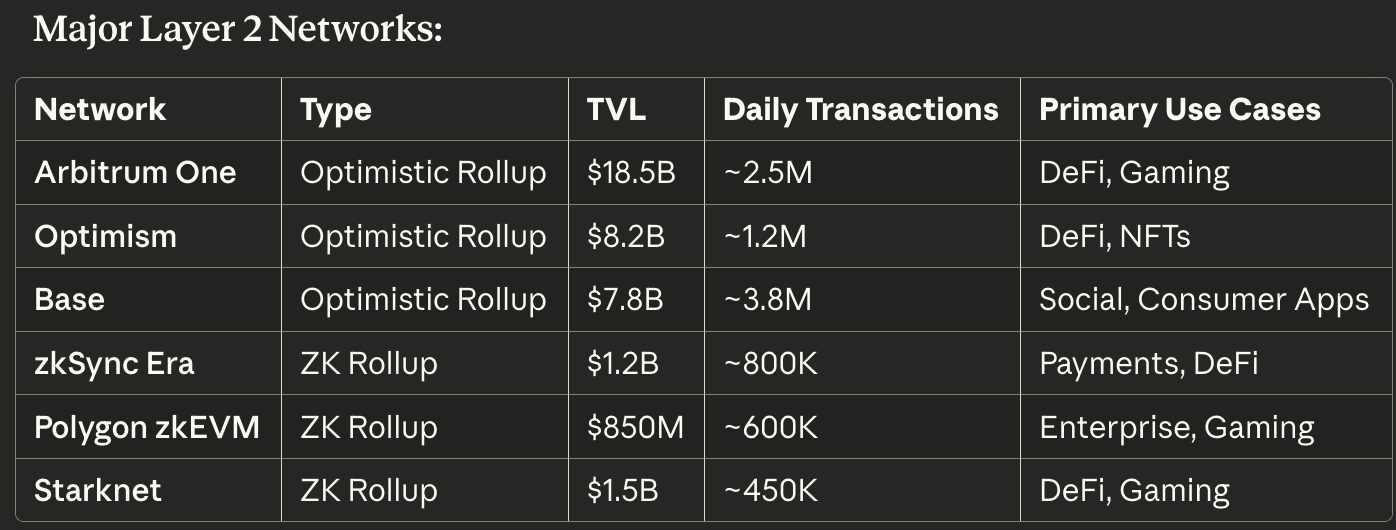
As of November 2025, Layer 2 rollups have become the primary scaling solution for Ethereum:
Combined, Layer 2 networks process over 10 million transactions daily, far exceeding Ethereum Layer 1's ~2 million.
How Layer 2s Use Blobs
Layer 2 rollups operate by:
Processing transactions off-chain: Thousands of transactions bundled and executed on the rollup
Posting data to Ethereum: Compressed transaction data submitted as "blobs" to Layer 1
Inheriting security: Ethereum validators ensure blob data availability
Enabling withdrawals: Users can exit to Layer 1 using posted blob data
Current blob economics (pre-Fusaka):
Each blob stores 128 KB of compressed transaction data
Blob target: 6 per block, maximum: 9 per block
Average blob fee: $0.10-$1.50 per blob (depending on demand)
Layer 2 transaction cost: $0.01-$0.50 per transaction
During periods of high Layer 2 activity, all 9 blob slots fill quickly, causing:
Blob fee spikes: Prices can reach $5-$10 per blob during congestion
Layer 2 fee increases: Rollups pass costs to users
Delayed transactions: Layer 2s wait for cheaper blob slots
Reduced throughput: Constrained by Layer 1 blob capacity
Fusaka's Impact on Layer 2 Economics
Immediate benefits (December 3, 2025):
While blob capacity remains at 6/9 initially, PeerDAS infrastructure enables:
Reduced blob verification overhead: Lower operational costs for rollup operators
Improved stability: More predictable blob fee market
Foundation for scaling: Infrastructure ready for BPO increases
After BPO1 (December 17, 2025 - 10/15 blobs):
67% more blob space: From 6 to 10 target blobs
Reduced congestion: More consistent blob availability
Fee stabilization: Less volatile blob pricing
Estimated fee reduction: 30-40% average decrease in blob costs
After BPO2 (January 7, 2026 - 14/21 blobs):
133% more blob space vs. pre-Fusaka: From 6 to 14 target blobs
Significantly reduced congestion: Blob slots rarely completely filled
Dramatic fee reduction: 50-70% lower average blob costs
Throughput increase: Layer 2s can post data more frequently
Conclusion
Ethereum's Fusaka upgrade on December 3, 2025, makes the network far more efficient without adding complexity for users.
Here's the simple version: right now, every computer validating Ethereum transactions has to download and check all the data, which is slow and expensive. Fusaka introduces PeerDAS technology that lets validators verify data by checking small random samples instead of everything, like a quality inspector checking random items off an assembly line rather than every single product.
Ethereum can now handle 8 times more data from popular Layer 2 networks like Arbitrum, Optimism, and Base where most people actually use crypto.
For you as a user, nothing changes on your end: your wallet works the same, your crypto stays put, and you don't need to do anything. You'll just notice over the next few months that using Ethereum apps costs less and works faster, especially on Layer 2 platforms where fees have been the biggest pain point.