Wintermute has Dumped 40% Of Its Holdings In The Last 3 Weeks, rumoured to have been caused by 10.10
Wintermute, one of crypto’s largest market makers, has seen its visible onchain balances drop by roughly 30–40% in just three weeks, alongside repeated BTC and ETH transfers to major exchanges like Binance and Bitstamp. While market makers routinely move inventory, the scale, persistence, and direction of these flows raise a legitimate question: is Wintermute quietly reducing exposure or actively selling?
In crypto, few narratives spread faster than the idea that a major market maker is exiting risk. Over the past several weeks, onchain data has provided enough raw material to keep that story alive.
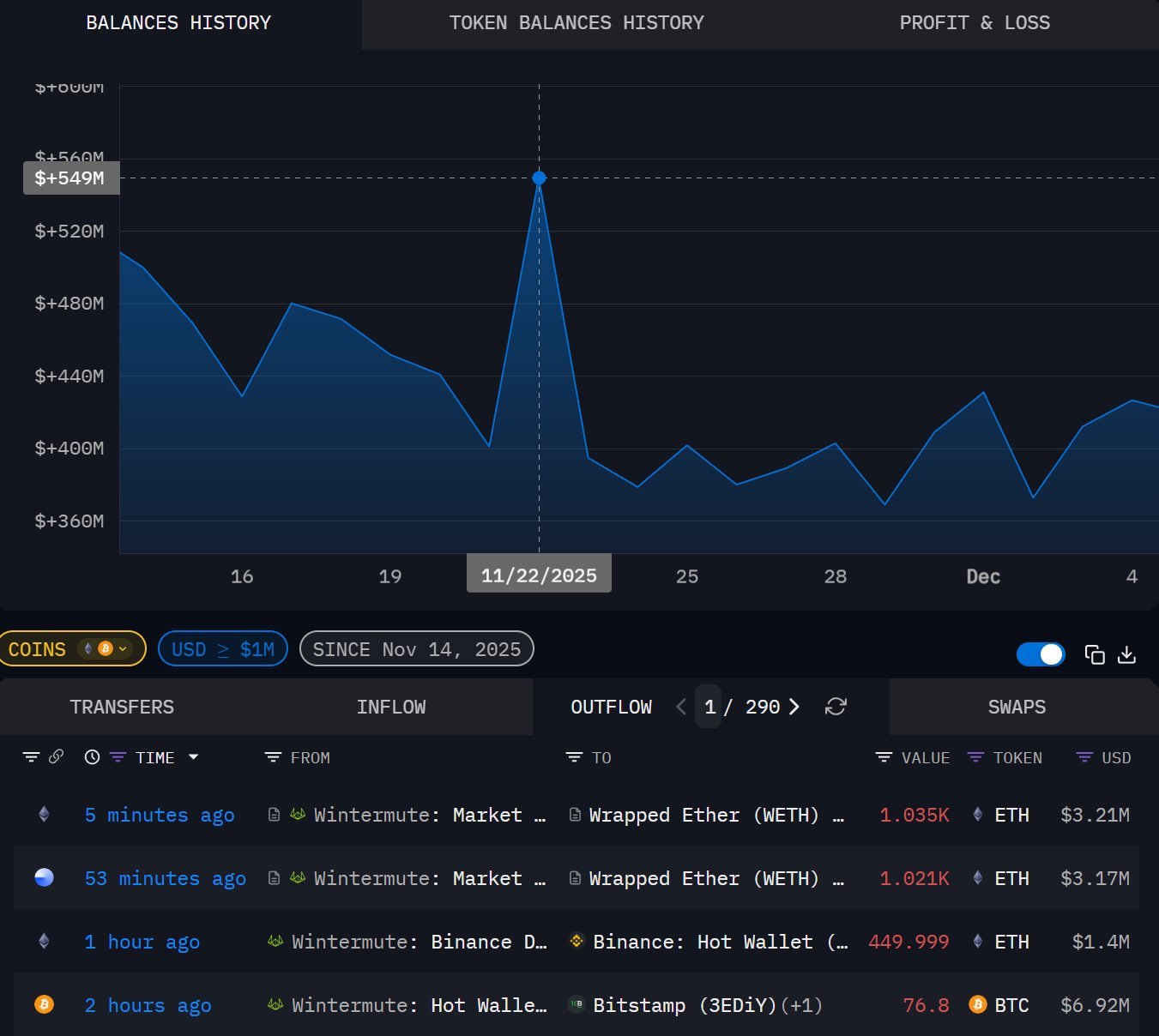
At its peak around November 22, wallets attributed to Wintermute held approximately $540–550 million in assets. By early December, that number had fallen to as low as $320–370 million, before rebounding modestly into the $400 million range.
That represents a 30–40% drawdown in visible balances over a short time window, a magnitude that naturally commands attention.
At the same time, transaction logs show:
repeated ~1,000 ETH transfers to wrapped ETH and Binance hot wallets
dozens of BTC sent to centralized exchanges including Binance and Bitstamp
large aggregate outflows measured in the hundreds of millions of dollars
It is persistent, directional flow.
The Strongest Data Points Supporting the Dumping Thesis
To argue that Wintermute may actually be selling, three concrete observations matter most.
1. Scale and Speed of Exchange-Directed Outflows
Onchain tracking services estimate that over $1.5 billion in crypto assets (BTC, ETH, and SOL combined) were transferred from Wintermute-linked wallets to centralized exchanges over roughly three weeks.
Market makers move inventory, but this magnitude over this time frame is unusual, particularly when paired with a sharp decline in retained balances.
If these transfers were purely for liquidity provisioning, one would expect:
more balanced inflows and outflows
or a faster return of inventory back to known wallets
Instead, balances dropped rapidly and remained lower.
2. Persistent Net Decline in Labeled Wallet Balances
Operational rebalancing typically produces churn, not sustained depletion.
Here, the data shows:
a clear peak
a sharp drop
partial stabilization at a much lower baseline
That pattern is consistent with risk reduction, not simple rotation.
While some assets may have moved to unlabeled wallets or custodians, the net visible exposure declined materially and stayed down.
3. Directional Timing With Market Weakness
Several large transfers coincided with periods of price softness in BTC and ETH.
While correlation is not causation, large liquidity providers selling into weakness can:
exacerbate short-term downside
increase liquidation cascades
amplify volatility
Why “Market Making” Alone May Not Fully Explain This
The strongest counterargument is that Wintermute is simply doing what market makers do. That argument is valid but incomplete.
Market makers usually:
maintain inventory to support spreads
reduce exposure after volatility subsides
avoid signaling directional bias
What makes this episode different is:
the depth of the drawdown
the persistence of exchange-directed flows
the lack of a clear re-accumulation phase
This does suggest active balance-sheet contraction.
A More Plausible Middle Ground: Controlled De-Risking That Looks Like Selling
The most defensible interpretation may be uncomfortable for both extremes.
Wintermute may not be “dumping” in a reckless sense but the data supports the idea that it is intentionally reducing gross exposure to BTC and ETH.
That can involve:
selling inventory into rallies
netting down client flows without replacing them
keeping capital more liquid amid macro uncertainty
From an onchain perspective, de-risking and selling are indistinguishable.
The chain only sees tokens leaving.
Why This Matters More Than a Twitter Narrative
Wintermute is not just another whale. It is a core liquidity provider across:
Bitcoin and Ethereum spot markets
derivatives
altcoin order books
When a firm of this size reduces inventory, the effects can ripple outward:
thinner liquidity
sharper moves
more violent liquidations
That does not imply malice or insider knowledge, only prudent risk management but the market impact is real.
What Would Definitively Prove Dumping?
The final piece of evidence would require data the public does not have:
executed sell orders on exchange books
internal hedging records
counterparty settlement details
Absent that, the chain can only show movement, not intent.
Bottom Line
The onchain evidence does not conclusively prove that Wintermute is dumping Bitcoin and Ethereum but it does strongly support the idea that the firm has materially reduced exposure over a short period.
The scale, persistence, and direction of flows go beyond routine noise.
The most honest conclusion is this:
Wintermute appears to be actively de-risking, and that de-risking may include real selling . even if it is controlled, professional, and far from panic.
In markets, perception often matters as much as intent. Right now, the chain is telling a story that cannot be dismissed.