KOSPI’s 8% Plunge Shows the AI Chip Trade Has Entered Its Fear Phase
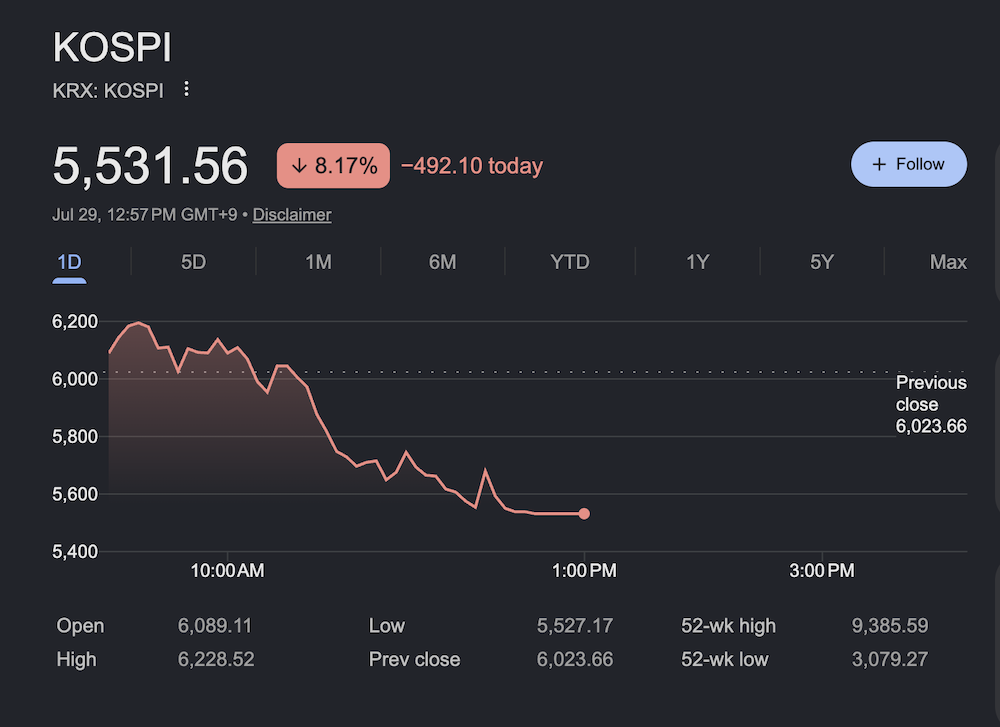
South Korea’s stock market was thrown into fresh turmoil on Wednesday as the KOSPI sank about 8% in intraday trading, falling to roughly 5,530–5,550 and reaching the threshold for another market-wide trading halt. The collapse extended one of the most violent reversals in the index’s history, following Tuesday’s 10.84% fall to 6,023.66. By midday in Seoul, the index was trading at 5,547.77.
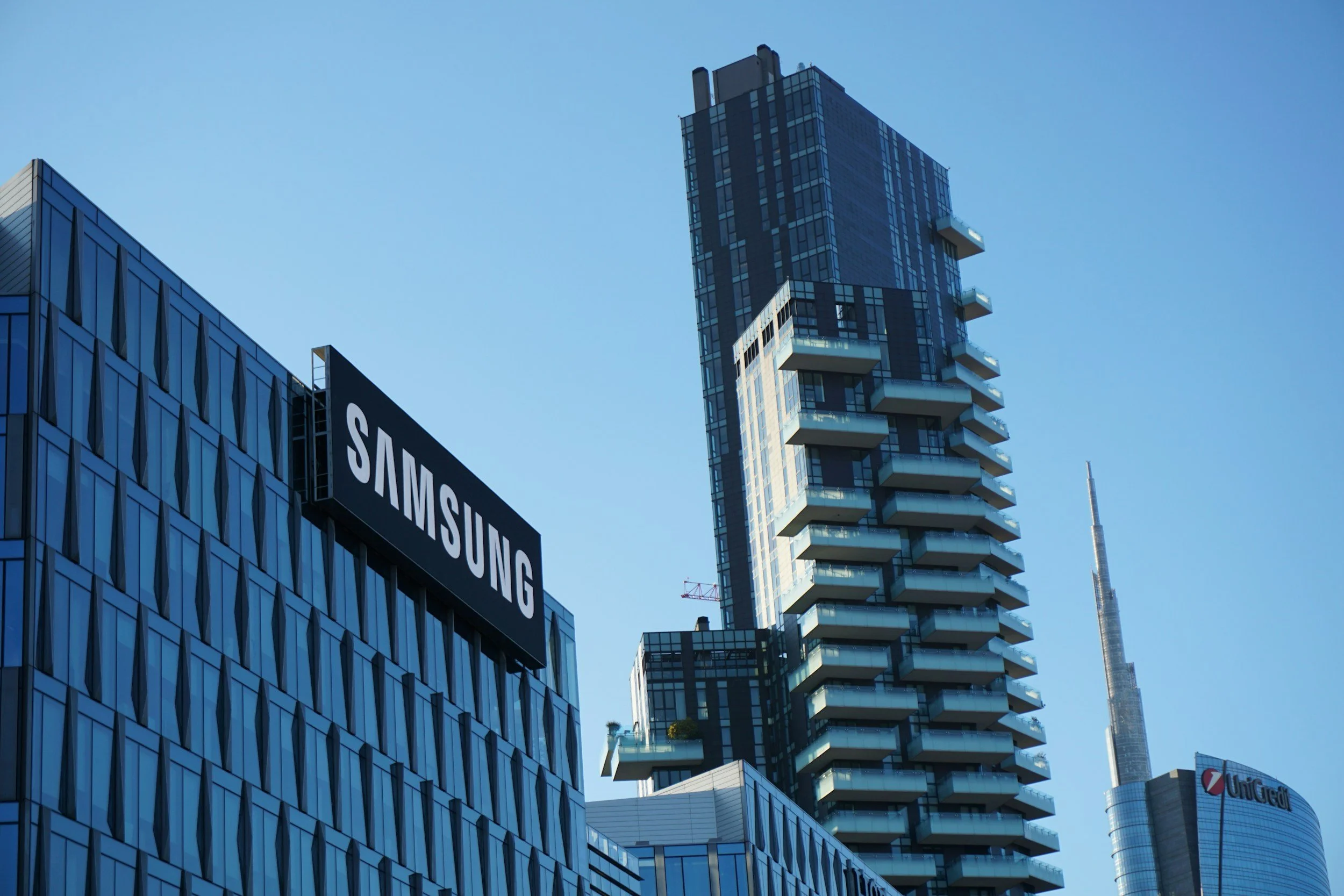
At the centre of the rout were Samsung Electronics and SK Hynix, the two semiconductor giants that had powered the KOSPI’s extraordinary rise earlier this year. Their size is now working in reverse. Because the pair account for more than half of the index’s weighting, losses in the chipmakers are not merely dragging down the technology sector; they are pulling the entire Korean market with them.
The numbers capture the speed of the reversal. The KOSPI has fallen about 30% in July and roughly 40% from its June record close of 9,114.55. Tuesday’s sell-off was already the index’s largest one-day decline since March, while Wednesday’s renewed plunge brought another wave of forced selling. What had recently been one of the world’s strongest equity rallies has become one of its sharpest bear markets.
Yet the sell-off is not being driven by collapsing current demand. SK Hynix has just reported record quarterly operating profit, supported by strong demand for high-bandwidth memory used in artificial-intelligence servers. Its shares nevertheless fell sharply because revenue and operating profit failed to meet expectations that had risen even faster than the company’s earnings.
That distinction matters. Markets do not price whether a company is doing well; they price whether it is doing better than investors had already assumed. When expectations become extreme, even spectacular results can be treated as disappointments. SK Hynix’s results therefore became evidence not that the AI boom had ended, but that the market may have priced in too perfect a version of it.
The first source of anxiety is AI spending itself. Technology companies have committed enormous sums to data centres, accelerators and memory, creating a powerful demand cycle for suppliers such as Samsung and SK Hynix. Investors are now asking when those investments will produce adequate returns. The concern is shifting from how much computing capacity can be built to whether customers can monetise it fast enough.
“With expectations for AI capex already elevated, investors appear to be taking some risk off the table,” said Gary Tan, a portfolio manager at Allspring Global Investments. Major US technology earnings and the Federal Reserve’s interest-rate decision have added further uncertainty around both AI spending and market liquidity.
The second threat comes from China. The successful market debut of ChangXin Memory Technologies, or CXMT, and reports of progress in domestically produced lithography equipment have challenged the assumption that Korean manufacturers will retain an unassailable lead in advanced memory.
“The market’s concern lies less in CXMT’s current earnings” than in its ability to accelerate production and technological development, said Kim Seok-hwan, a market analyst at Mirae Asset Securities. That fear is forward-looking: investors are not claiming CXMT can immediately displace Korean suppliers, but they are pricing the possibility that new capacity eventually weakens margins and accelerates another memory glut.
This is particularly dangerous in semiconductors because the industry has always been cyclical. High prices encourage investment; investment creates supply; and excess supply eventually pushes prices and profits lower. AI-related memory had been treated as an exception because of its technical complexity and rapidly growing demand. The recent rout suggests investors are beginning to wonder whether it is merely a more profitable version of the same old cycle.
SK Hynix continues to reject the most pessimistic interpretation. “Major customers are still requesting more memory supply,” company president Song Hyun-jong told investors. The chipmaker has concluded talks on about 10 long-term supply agreements intended to reduce its exposure to abrupt changes in demand and pricing.
Leverage is intensifying the fall. Foreign investors sold about 5 trillion won of Korean shares on Tuesday, while retail investors bought roughly 4 trillion won. But heavily leveraged positions and single-stock leveraged exchange-traded funds can turn an orderly correction into forced liquidation. When prices fall, margin calls compel investors to sell regardless of their long-term view, creating another round of losses and further margin calls.
Circuit breakers can pause this process, but they cannot remove the underlying imbalance. A 20-minute halt may allow orders to settle and emotions to cool, yet repeated activations also signal how disorderly the market has become. This year’s unusually frequent trading halts reflect not only anxiety over the chip cycle but the fragility created by a rally concentrated in a handful of highly volatile stocks.
The bullish case has not disappeared. Earlier in July, some estimates placed the KOSPI at only about 6.4 times forward earnings, a valuation associated with severe distress rather than a market still generating rapid profit growth. Citi recently argued that capital-flow pressure was easing while Korea’s “strong economic fundamentals and market-friendly policy mix” were becoming increasingly supportive.
For contrarian investors, that combination—record profits, collapsing prices and low forecast valuations—may look compelling. Francis Tan, chief strategist for Asia at Indosuez Wealth Management, described the earlier decline as “a great time to buy in,” while warning that chips remain “a volatile game.”
But the 6.4-times multiple should not be treated as a guarantee of safety. Forward earnings are estimates, and those estimates may be revised lower if memory prices weaken, AI capital expenditure slows or Chinese competition compresses margins. A market can look cheap because investors are panicking, or because analysts have not yet cut their forecasts. The difference only becomes clear later.
The most important question is therefore not whether the KOSPI has fallen enough. It is whether the assumptions supporting Korean chip earnings remain intact. Investors will be watching hyperscaler spending plans, HBM contract pricing, capacity expansion, Chinese production yields and any evidence that data-centre customers are delaying orders.
For now, the KOSPI’s plunge marks a change in market psychology. During the rally, investors feared missing the AI boom. During the crash, they fear discovering that its profits were temporary. The underlying technology has not vanished, and demand for advanced memory remains substantial. But the burden of proof has shifted.
Samsung and SK Hynix must now show that record earnings can survive record investment, rising competition and a market no longer willing to pay for perfection. Until then, low valuations may attract bargain hunters, but every rebound will face the same question: is this the bottom of a panic, or the beginning of a deeper semiconductor bust?